
Homemade mayonnaise relies on a simple physical mechanism: dispersing droplets of oil into an aqueous phase (the egg yolk) to form a stable emulsion. The whisk or mixer you use determines the fineness of this dispersion, thus affecting the consistency and texture of the sauce. Choosing the right tool starts with understanding what happens in the bowl.
Emulsion and Shear: What the Tool Actually Does to Mayonnaise
An emulsion like mayonnaise requires the oil to be broken down into microscopic droplets, kept in suspension by the lecithin in the egg yolk. The smaller and more uniform the droplets, the firmer and shinier the sauce.
The parameter that governs this fragmentation is shear, the mechanical force exerted on the mixture by the wires or blade of the tool. A manual whisk with flexible wires produces moderate shear. An electric mixer increases the frequency of this shear. An immersion blender generates a concentrated vortex that far exceeds the first two in intensity.
The choice is therefore not just a matter of comfort. Each tool produces a different texture of mayonnaise, due to the speed and consistency with which it incorporates the oil into the yolk.
The question of which whisk or mixer for homemade mayonnaise then depends as much on the volume prepared as on the desired result.
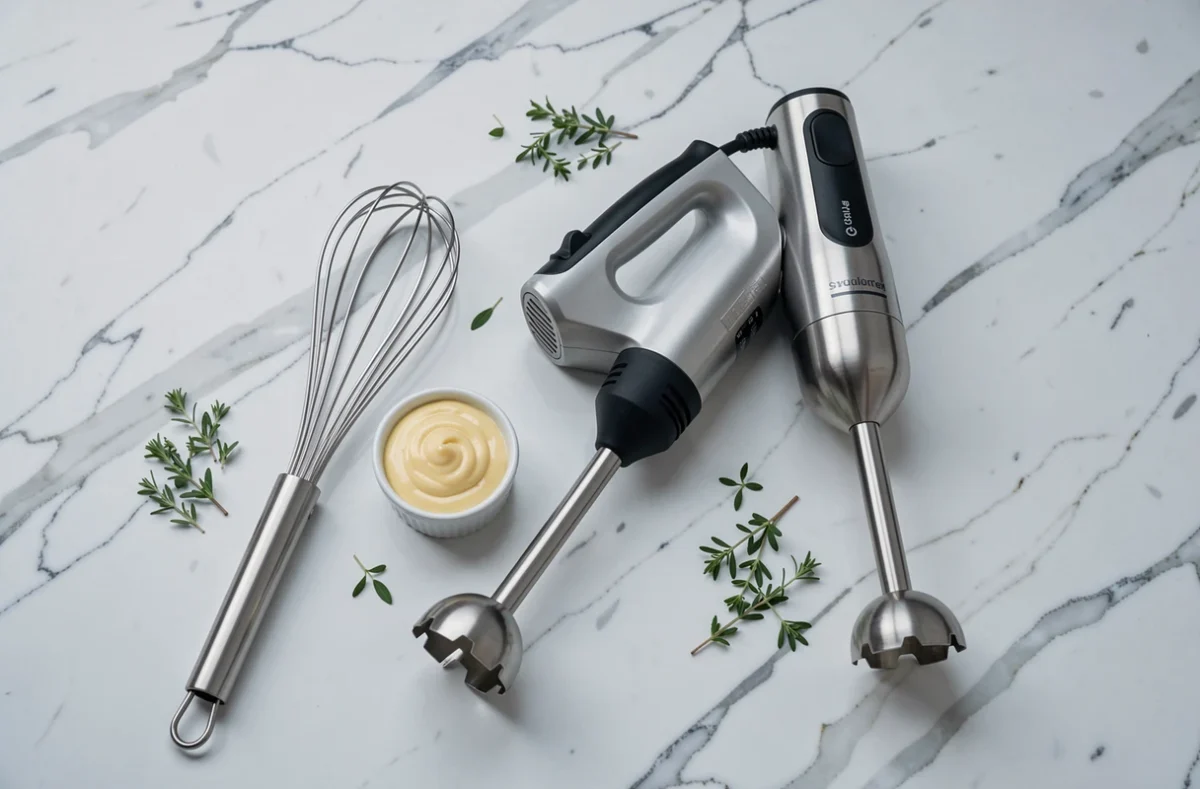
Manual Whisk, Electric Mixer, or Immersion Blender: Compared Performance
Stainless Steel Manual Whisk
The classic balloon whisk remains the reference tool for making mayonnaise. Its spaced wires gradually incorporate air and oil, allowing for fine control over the consistency. However, it requires a steady and sustained motion, and the incorporation of the oil must be slow and continuous to prevent the emulsion from breaking.
It is suitable for medium quantities, with one or two egg yolks. Beyond that, wrist fatigue reduces the consistency of the motion, and the risk of failure increases.
Electric Mixer with Whisks
The electric mixer addresses the issue of consistency. Its constant speed maintains uniform shear, reducing the risk of separation. It works well in a standard-sized bowl.
The weak point: most electric mixers splash the preparation onto the sides of the bowl, especially at the beginning when the volume is low. With just one egg yolk, the whisk sometimes spins in the air. A narrow and deep bowl mitigates this problem, but not all models adapt to it.
Immersion Blender in a Narrow Container
For small quantities, the immersion blender in a tall, narrow glass is the most forgiving method. The blade creates a concentrated vortex that gradually pulls the oil into the yolk without complex manual intervention. You simply place the blade at the bottom, hold it still for a few seconds, and then slowly lift it as the emulsion forms.
This technique tolerates imprecise measurements and even works with a whole egg. The container matters almost as much as the device: a glass that is too wide dissipates the vortex and compromises the initial emulsion.
The Role of the Container in the Success of the Emulsion
Cooking guides emphasize the choice of the tool without mentioning the container, while the geometry of the bowl radically alters the behavior of the sauce.
- A wide and shallow bowl is suitable for the manual whisk: it offers amplitude to the circular motion and allows for easy scraping of the edges. However, the yolk spreads in a thin layer, making the initial additions of oil delicate.
- A tall and narrow container (like a measuring cup or beaker) is preferred with the immersion blender: the blade remains submerged, and the contact between oil and yolk is maximal from the start.
- An intermediate-sized bowl with a rounded bottom works better for the electric mixer: it reduces splashes and keeps the yolk centered under the whisks.
If you regularly find that your mayonnaise takes a long time to set or remains liquid, change the container before changing the tool. The same whisk can succeed or fail depending on the bowl used.

Ingredient Temperature and Margin of Error Depending on the Tool
Temperature influences the viscosity of the oil and the yolk’s ability to stabilize the emulsion. Technical sources recommend bringing the temperature of the egg and oil closer together before starting. An egg taken out of the refrigerator in oil at room temperature creates a thermal gap that makes the emulsion more fragile.
With a manual whisk, this gap is felt more acutely: the slowness of incorporation allows time for the components to mix poorly. The immersion blender, thanks to its intense shear, tolerates a slight temperature discrepancy better.
Field feedback varies on this point. Some cooks successfully make their mayonnaise with a cold egg using the blender, while the same operation with a whisk consistently fails. The fastest tool offers the widest margin of error regarding temperature, but does not exempt from basic precautions.
Maintenance and Practicality in Daily Use
A criterion often overlooked: cleaning. Mayonnaise is greasy and adheres to the fine wires of the balloon whisk. A stainless steel whisk with welded wires (without hollow space at the junction) cleans much more easily than a model with a hollow handle where grease can infiltrate.
The immersion blender rinses easily by running it for a few seconds in a glass of soapy water. The electric mixer requires detaching the whisks, which adds an extra step. In daily cooking, the ease of cleaning influences the choice as much as performance.
- Monobloc stainless steel manual whisk: the easiest to maintain, dishwasher safe without risk.
- Immersion blender: quick cleaning if the foot is detachable and dishwasher safe.
- Electric mixer: detachable whisks are easy to wash, but the body of the device should never be submerged.
Ultimately, the choice of whisk or mixer for homemade mayonnaise depends on three concrete variables: the quantity prepared, the available container, and the tolerance you allow for imprecise measurements of dosage or temperature. A manual whisk in a good bowl remains reliable. An immersion blender in a narrow glass is more forgiving. The electric mixer falls in between, effective as long as the container is adapted.