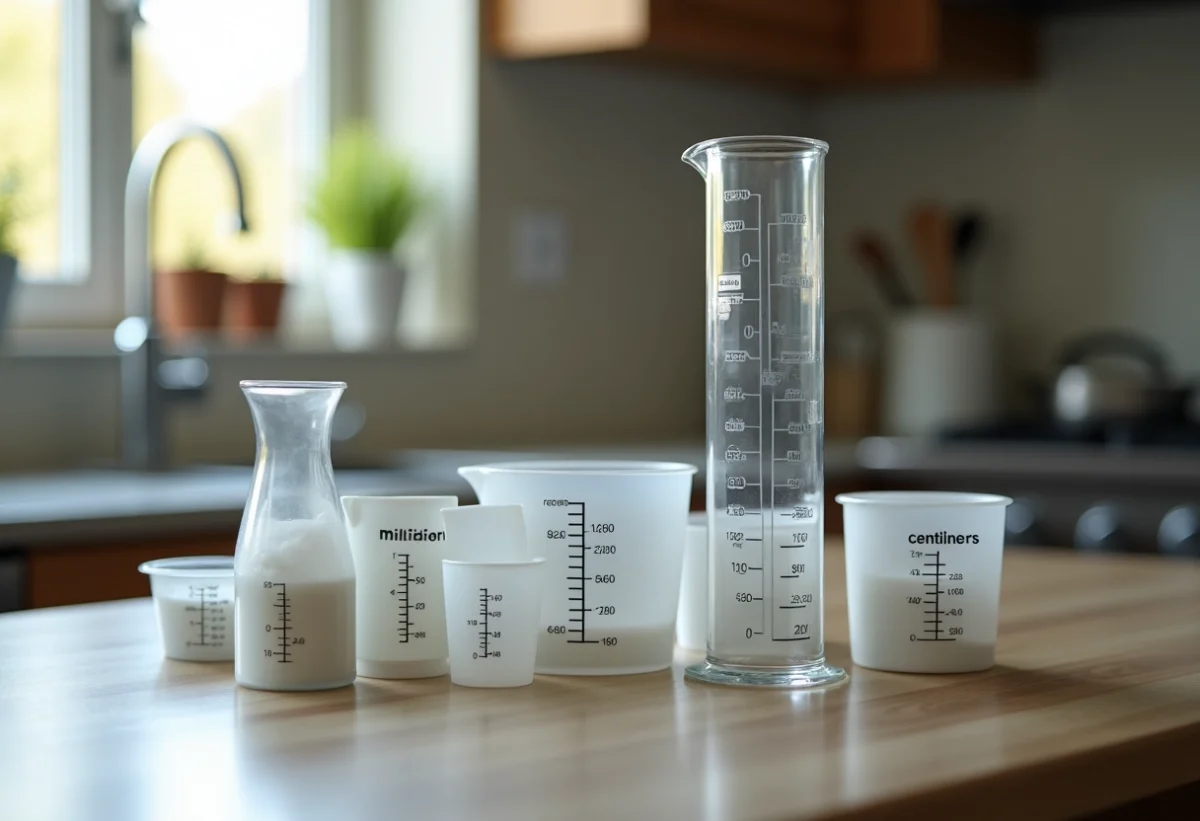
In cooking, the precision of measurements can make all the difference between a successful dish and a culinary failure. Often, recipes use volumes in milliliters, while others prefer centiliters, sometimes creating confusion. Understanding how to convert these units is essential for following any recipe smoothly.
Take the example of a sauce recipe that calls for 250 milliliters of broth, but your measuring cup shows centiliters. Knowing that 250 milliliters is equivalent to 25 centiliters allows you to follow the recipe accurately and achieve the desired flavor. This mastery of conversions brings fluidity and confidence in the kitchen, making culinary experiences even more enjoyable.
Understanding Measurement Units in Cooking: Milliliters and Centiliters
Cooking, chemistry, and pharmacy commonly use measurement units such as milliliters and centiliters. The milliliter, belonging to the International System of Units (SI), is equal to 0.001 liters. The centiliter, also from the SI system, represents 0.01 liters. These units are essential for accurately measuring liquids and substances.
For a simple conversion between these two units, remember this basic rule: 1 centiliter equals 10 milliliters. If a recipe requires 300 ml in cl, that corresponds to 30 centiliters. This quick conversion is fundamental for adjusting measurements based on the available tools, whether it’s a measuring cup graduated in milliliters or centiliters.
Various fields such as chemistry and pharmacy also utilize these units for precise dosing. In the laboratory, the exact conversion between milliliters and centiliters ensures unmatched precision in experiments and medication preparation.
- 1 centiliter = 10 milliliters
- 1 milliliter = 0.1 centiliter
Used in contexts as diverse as cooking recipes and pharmaceutical formulations, these units allow for the standardization necessary for reproducibility and reliability of preparations. Follow these conversions rigorously for optimal precision in all your measurements. 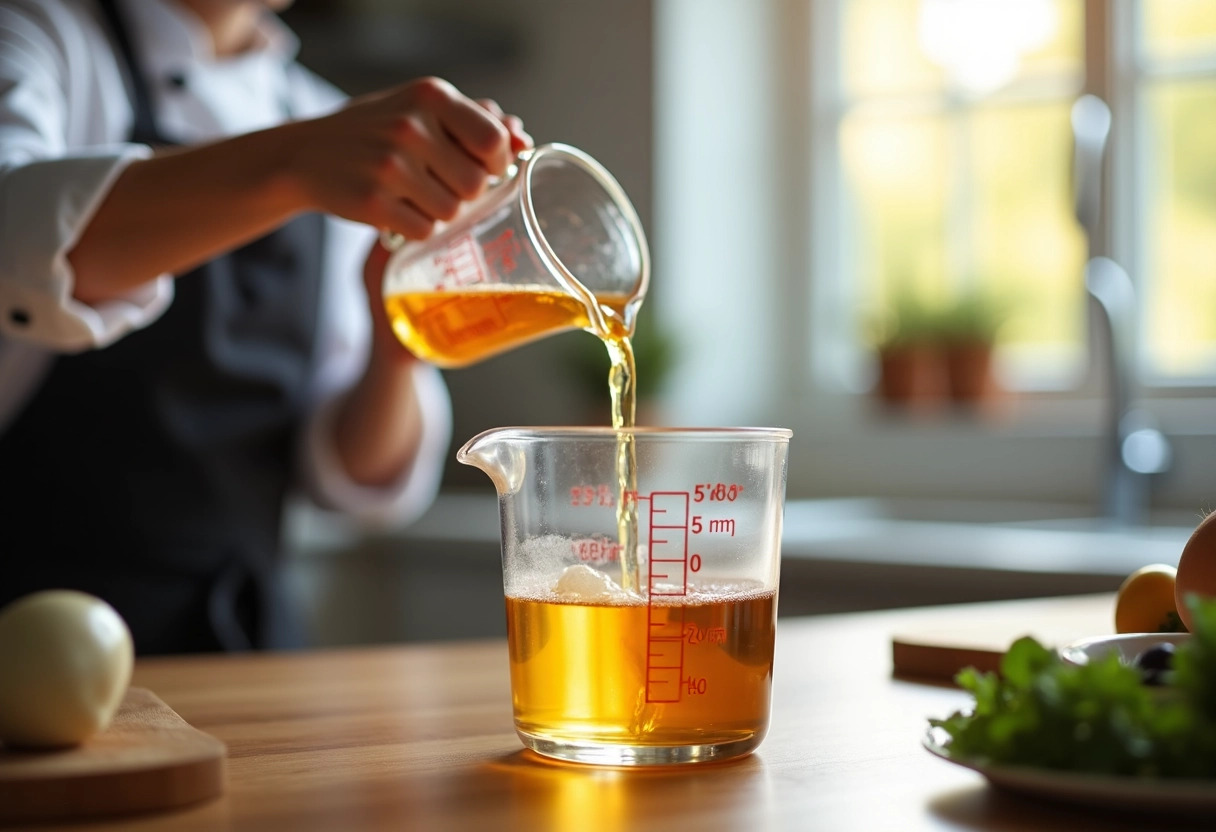
Techniques and Tips for Easily Converting Volumes in Cooking
To master conversions between milliliters and centiliters, several tools and techniques can be used. The basic rule remains simple: 1 centiliter equals 10 milliliters. Learn to use this rule for all your conversions.
An essential tool in the kitchen is the conversion chart. Easy to consult, it allows you to quickly visualize the equivalences between different volume units. For example, if a recipe calls for 250 milliliters of milk, the chart will indicate that it is 25 centiliters.
- 1 centiliter = 10 milliliters
- 5 centiliters = 50 milliliters
- 10 centiliters = 100 milliliters
The kitchen scale is another valuable ally. Some scales offer automatic conversion functions, making it easy to switch from one unit to another effortlessly. Use this feature to avoid calculation errors and ensure the accuracy of your preparations.
In the laboratory or pharmacy, the same principles apply. The precise conversion of volumes is fundamental for the formulation of medications or conducting chemical experiments. Using graduated instruments in milliliters or centiliters ensures accurate and reproducible measurements.
In your kitchen, adopt tools like the graduated measuring cup, which allows you to measure directly in milliliters and centiliters. This practical approach simplifies recipe preparation and ensures precise dosing of liquid ingredients.