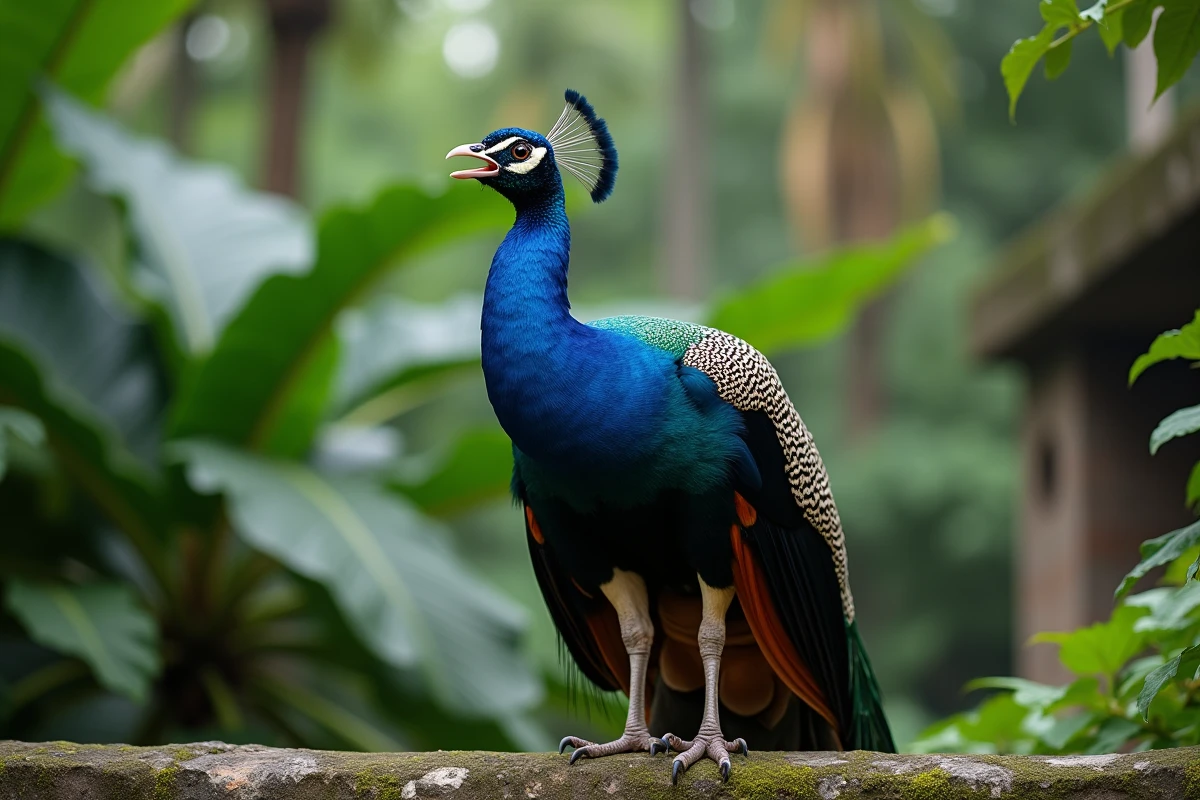
The male peacock, Pavo cristatus, produces a powerful call audible for several hundred meters. This peacock cry, often described as a strident and repeated “leon,” both confounds and fascinates. Behind this hoarse sound lie precise biological mechanisms and multiple functions related to reproduction, territorial defense, and social communication within the group.
Vocal Anatomy of the Peacock: What Produces Such a Powerful Cry
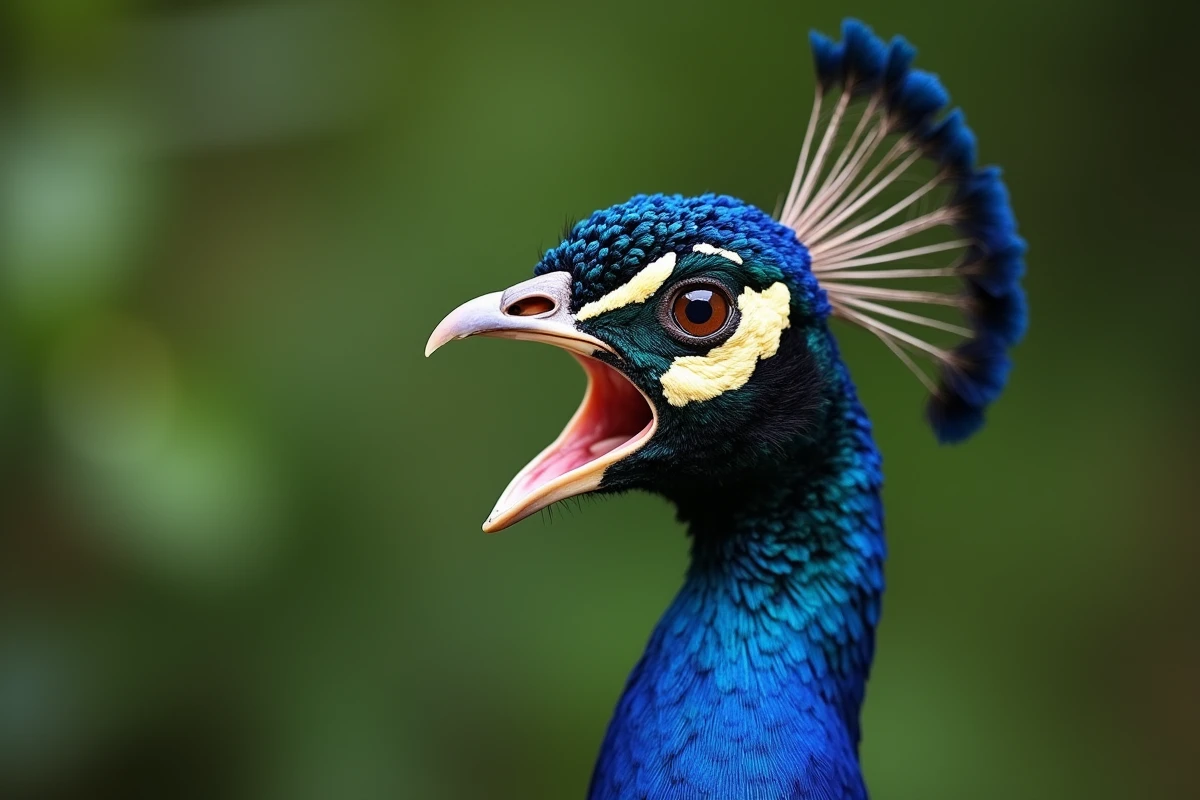
Most descriptions of the peacock’s cry stop at its unpleasant nature. The responsible organ, the syrinx, deserves particular attention. Located at the junction of the trachea and bronchi, the syrinx of gallinaceous birds (the family to which the peacock belongs) functions differently from that of songbirds.
In the peacock, the membranes of the syrinx vibrate under high air pressure, generating low frequencies and piercing harmonics. The structure of the syrinx explains the hoarse tone of the cry. The bird modulates the opening of its air sacs to amplify the sound, somewhat like a natural resonating chamber.
This vocal power is no accident. It allows the male to cover a large territory, even in a dense forest environment where obstacles absorb some of the sound. To learn everything about the peacock’s cry, one must first understand that this vocalization is a survival tool before being a signal of attraction.

Peacock Cry and Courtship Display: A Complementary Signal to the Train
One spontaneously associates the peacock’s display with its spectacular train, those feathers with eye-shaped ocelli fanned out. The cry plays an equally active role in the seduction process, even if it is less photogenic.
Coordination Between Vocalization and Plumage
During the breeding season, the male combines the display of his train with series of close cries. The cry often precedes the opening of the train by a few seconds, as if to attract the attention of females before the visual demonstration. Peahens, drawn by the sound, come closer and then assess the quality of the plumage.
This coordination suggests that sexual selection in peacocks does not rely solely on visual criteria. The frequency, intensity, and regularity of the cry also seem to play a role in female choice, although the available data do not allow for a definitive conclusion on the hierarchy between auditory and visual signals.
An Indicator of Vigor
Producing a powerful and repeated cry requires energy. A weakened, parasitized, or poorly nourished male will have more difficulty maintaining sustained vocalizations over several hours. The cry functions as an indirect indicator of the male’s health. This principle aligns with the handicap theory in evolutionary biology: a costly signal to produce becomes reliable precisely because it cannot be faked.
Territorial Function and Social Communication of the Cry
Reproduction does not explain all the vocalizations of the peacock. Outside the breeding season, peacocks continue to cry, sometimes at night, which regularly exasperates residents in parks and gardens where the species lives in semi-freedom.
- The territorial cry signals the presence of a dominant male in a given area and deters competitors from approaching.
- The alarm cry, shorter and higher-pitched, warns the group of the presence of a terrestrial (fox, stray dog) or aerial (raptor) predator.
- Nocturnal vocalizations seem linked to disturbances (unusual noises, movements in the dark) and play a role in collective vigilance.
Peacocks also cry in response to the cries of other peacocks, creating chain vocal exchanges. In large groups, these sound dialogues structure the hierarchy and maintain group cohesion, even when individuals cannot see each other through the vegetation.
The Peacock in Mythology and Beliefs: A Bird Between Beauty and the Sacred
The fascination with the peacock’s cry is not new. In Greek mythology, the peacock is associated with Hera, the goddess of marriage and nature. According to the tale, the eyes on the peacock’s feathers come from Argos, the giant with a hundred eyes, after his death. The plaintive cry of the bird has sometimes been interpreted as a lamentation related to this mythical origin.
In Hindu traditions, the peacock accompanies several deities. Its cry, far from being perceived as unpleasant, heralds the monsoon and symbolizes renewal. The peacock is the national bird of India, a status that reflects its place in the collective imagination far beyond the mere beauty of its plumage.
In contrast, in some medieval European traditions, the peacock’s cry was associated with vanity, even a bad omen. This duality between visual admiration and auditory rejection traverses cultures and eras. Medieval Christian art sometimes represents the peacock as a symbol of immortality, its feathers seeming never to decompose, while its cry reminded the faithful of the fragility of earthly beauty.
Noise Pollution and Coexistence with Domestic Peacocks
Owning peacocks in a garden or park involves managing their vocalizations. The peacock’s cry carries over long distances, and during the breeding season (spring and early summer), males can vocalize from dawn until late in the evening.
No reliable method exists to eliminate the cry without harming the animal. Some breeders report that a calm environment, a sufficiently large enclosure, and a balanced ratio between males and females reduce the frequency of vocalizations. Field reports vary on this point, as the individual temperament of each bird plays a notable role.
Regulations on noise pollution related to domestic animals vary by municipality. Before installing peacocks, checking local ordinances can prevent neighborhood conflicts that may escalate to court.
The peacock’s cry remains one of the most recognizable sounds in the animal world. Far from being a mere flaw of this spectacular bird, it fulfills precise biological and social functions that neither the train nor the plumage can ensure alone.