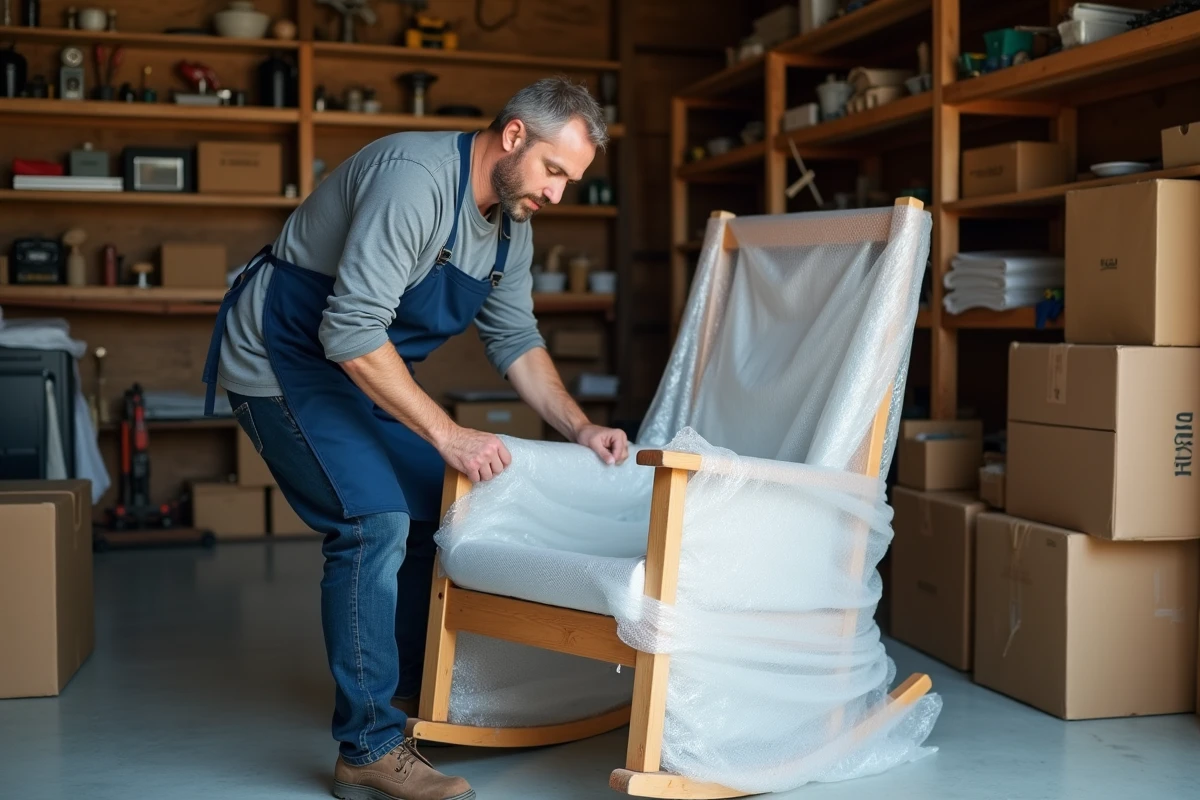
A poorly secured rocking chair in a standard box almost always arrives with a cracked glide or a broken armrest. The curved geometry of the glides, the overhang of the armrests, and the overall volume of the furniture make shipping a rocking chair significantly more demanding than that of a classic chair. Here we detail the technical points that make the difference between a piece of furniture delivered intact and a carrier claim.
Mechanical constraints specific to curved glides
The glides of a rocking chair bear almost all of the transport stresses. Their curvature creates two simultaneous problems: a point contact with the ground of the package (the furniture “rolls” inside) and a fragility at the ends, where the wood or metal thins out.
Blocking the rotation of the glides is the top priority. Without lateral support, each handling of the package causes a micro-tilt that wears the packaging from the inside. After a few transfers, the box gives way.
We recommend individually securing each glide with high-density foam blocks shaped like cradles. Classic expanded polystyrene crumbles under the repeated pressure of the curves, making it unsuitable here. Closed-cell polyethylene foam (type PE30 or equivalent) absorbs shocks without disintegrating. To learn how to ship a chair safely, securing the glides remains the determining factor.
If the glides are made of solid wood, a tightly wrapped corrugated cardboard sleeve around each curve, secured with reinforced tape, adds a layer of protection against scratches. For metal glides, a foam film is sufficient, but the fastening must prevent any slipping.

Partial disassembly and pallet packaging
Shipping an assembled rocking chair is rarely the right choice. The armrests, removable backrest, or footrests create leverage points that multiply the risks of breakage during lateral shocks.
What can be disassembled, should be disassembled
Most recent models are sold in kits or semi-disassembled. We advise returning to this state for shipping. Remove the armrests, cushions, footrests, and any screwed or clipped components. Each piece is packed separately in cardboard and labeled.
- Armrests: individually wrapped in foam film, then secured in a separate box with the screws in a labeled bag attached to the box
- Cushions and fabric covers: placed in a closed plastic bag to avoid stains, then in a lightweight box
- Main structure (seat + glides): secured on a pallet or rigid support with tightening straps
Pallet or wooden crate
Cardboard alone is not enough for the main structure. Public carriers increasingly refuse bulky furniture that is not palletized, and their liability limitation applies if the packaging is deemed insufficient. A standard pallet (80 x 120 cm) accommodates most rocking chairs once the removable elements are removed.
Secure the structure to the pallet with ratchet straps, not just stretch film. Stretch film provides protection against dust and moisture, but it does not hold a multi-kilogram piece of furniture during sudden braking. Ratchet straps on the pallet, then stretch film on top: this is the correct order.
Multi-layer packaging for fragile rocking chairs
The principle of multi-layer packaging is not a luxury for this type of furniture. Each layer has a specific function, and removing one weakens the whole.
- First layer (contact): polyethylene foam film directly on the wood or metal, to avoid scratches and absorb micro-vibrations
- Second layer (damping): high-density foam sheets on protruding areas (ends of glides, corners of armrests, top of the backrest)
- Third layer (rigidity): double-walled cardboard on all sides, adjusted and sealed with reinforced tape, not just regular packing tape
- Fourth layer (holding): strapping or banding around the package to prevent the cardboard from opening under pressure
For rattan or wicker chairs, add a layer of crumpled kraft paper between the foam film and the high-density foam. Natural woven fibers break sharply under a point shock, while crumpled paper distributes the pressure.
Labeling and choosing the right carrier for bulky furniture
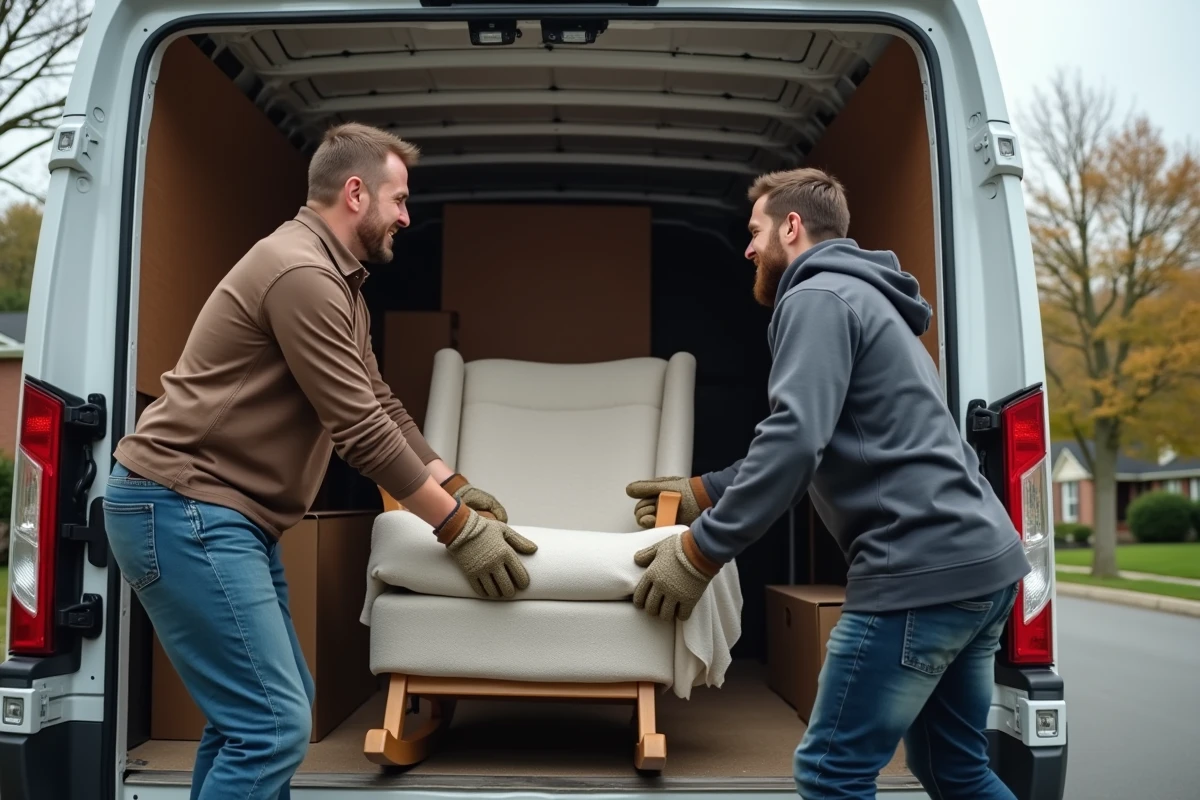
A poorly labeled package will be handled like a standard package. Affix “Fragile” and “Top/Bottom” labels on at least three visible sides. Add an arrow indicating the handling direction, as a package containing a rocking chair that is turned upside down experiences reversed stresses on the glides.
On the carrier side, we observe that standard courier services (small packages) are unsuitable for the size of a rocking chair, even when disassembled. Providers specialized in furniture or oversized package shipping offer transport and insurance conditions consistent with this type of item. Always check the liability limitation stated in the general conditions: some carriers exclude breakage of furniture not packaged according to their own packaging standards.
Photograph the furniture before packing, during the securing process, and the closed package. In case of a dispute, these photos serve as proof that the packaging was compliant. Without them, the carrier will almost always invoke a packaging defect to reject the claim.
Transporting a rocking chair does not tolerate approximation in securing the glides or in the rigidity of the packaging. Methodical disassembly, multi-layer packaging, and a carrier suited for bulky furniture drastically reduce the risk of breakage. Keep the labeled screws and packaging photos: these are your two safety nets in case of problems upon receipt.