
A productive garden relies as much on the choice of tools as on the technical gesture. Selecting the right equipment to maintain your garden requires thinking in systems: battery compatibility, regulated noise levels, and authorized pruning periods. We review the points that most consumer buying guides overlook.
Interchangeable battery platform: the real selection criterion for garden tools
Before comparing tools one by one, we recommend locking in the battery platform. The same battery should be able to power a mower, hedge trimmer, brush cutter, and blower. Check that the most energy-consuming devices, particularly the mower, actually work with the common battery from the range.
A coherent battery ecosystem reduces overall costs and simplifies storage. Several manufacturers offer this type of range, but not all batteries from the same brand are compatible across ranges. Read the technical sheet: voltage, amp-hour, and connectivity must match.
Also consider the take-back scheme. Used lithium-ion batteries should not be thrown in household waste. The nearest collection point and the take-back conditions vary by retailer. Among the equipment available on Jardin Jade, you will find ranges structured around this principle of interchangeability.
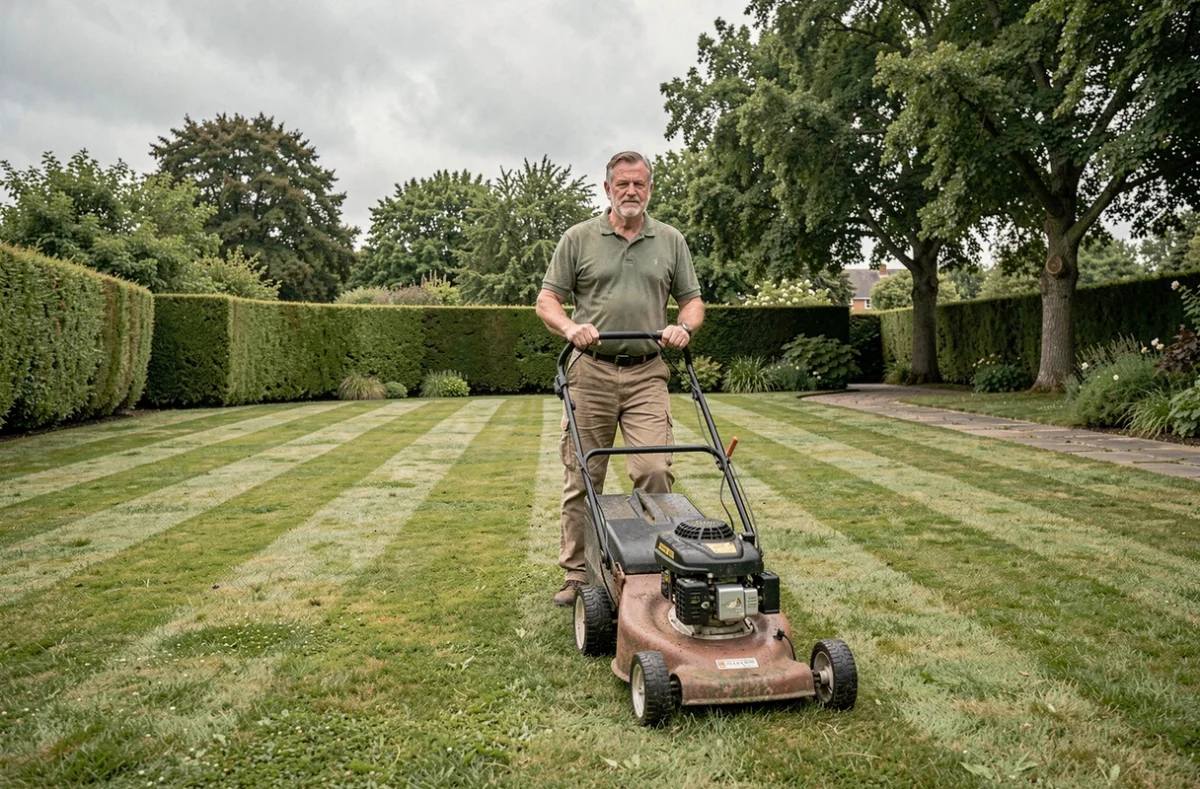
Noise regulations and hedge trimming: constraints to consider before purchase
The hours of use for powered tools vary from one municipality to another. Mowers, hedge trimmers, and brush cutters are regulated by prefectural or municipal orders. Noise can still be subject to penalties even during an authorized time slot if it is excessive in duration, repetition, or intensity.
This point has a direct consequence on the choice of equipment. A powerful but noisy thermal tool becomes unusable if your mowing slots are limited to a few hours on Saturday. Battery models generally have a lower noise level, which practically extends the usable time frame.
Robot mower: no regulatory exception
Programming a robot mower early in the morning or late in the evening does not exempt you. The legal criterion remains the actual nuisance perceived by the neighborhood, not the automatic or electric nature of the device. If the noise is perceptible, the complaint is valid.
Hedge trimming and nesting calendar
The agricultural orientation law of March 24, 2025, established a regime for the protection and sustainable management of hedges. The OFB recommends avoiding trimming from March 15 to July 31, and the LPO extends this recommendation until August 31. In a private garden, the presence of a nest must be checked before any hedge trimming intervention.
In practical terms, this means that your hedge trimmer will mainly be used in autumn and winter. A battery model, lighter and quieter than a thermal one, will be suitable for these short end-of-season sessions.
Hand tools for soil work: prioritize material durability
The spade, rake, trowel, and pruner form the foundation of any gardener. Competitors list them without focusing on what makes a difference in use: the materials of construction.
- Spade blade made of hardened steel or stainless steel: hardened steel retains its sharpness better in clay soil, stainless steel is more resistant to corrosion in acidic and damp soil
- Handle made of ash wood or composite fiber: ash absorbs vibrations, composite does not splinter and tolerates temperature variations
- Bypass or anvil pruner: the bypass blade produces a clean cut on green wood, the anvil is suitable for dry and dead wood
- Rake with welded fixed teeth or riveted teeth: welded teeth hold better on leveling rakes, riveted teeth can be replaced individually
We observe that the choice of blade type and handle significantly affects the lifespan much more than the brand itself. A bypass pruner with a steel spring costs more initially, but maintains its cutting precision for several seasons without frequent sharpening.

Personal protection and storage: two often overlooked areas
Gardening exposes you to real risks: projections during brush cutting, cuts, contact with treatment products. Safety glasses, reinforced gloves, and hearing protection for thermal tools are not optional.
- Leather-lined gloves for pruning (protection against thorns and splinters)
- Closed-side anti-projection glasses for the brush cutter and blower
- Hearing protection in the form of noise-canceling headphones if you use a thermal tool, even occasionally
Proper storage extends the lifespan of each tool. Spade and pruner blades rust if they remain in contact with damp soil. Hang hand tools, store lithium-ion batteries at room temperature, and clean blades after each use with an oiled cloth.
Regular maintenance of equipment is cheaper than premature replacement. Sharpen pruner blades at the beginning of the season, check the condition of air filters on thermal engines, and check the tire pressure of the mower before the first spring mowing.
Choosing your garden equipment while considering local regulations, battery compatibility, and material quality avoids unpleasant surprises in use. Noise level, nesting period, and battery take-back schemes are as crucial as the power indicated on the packaging.